
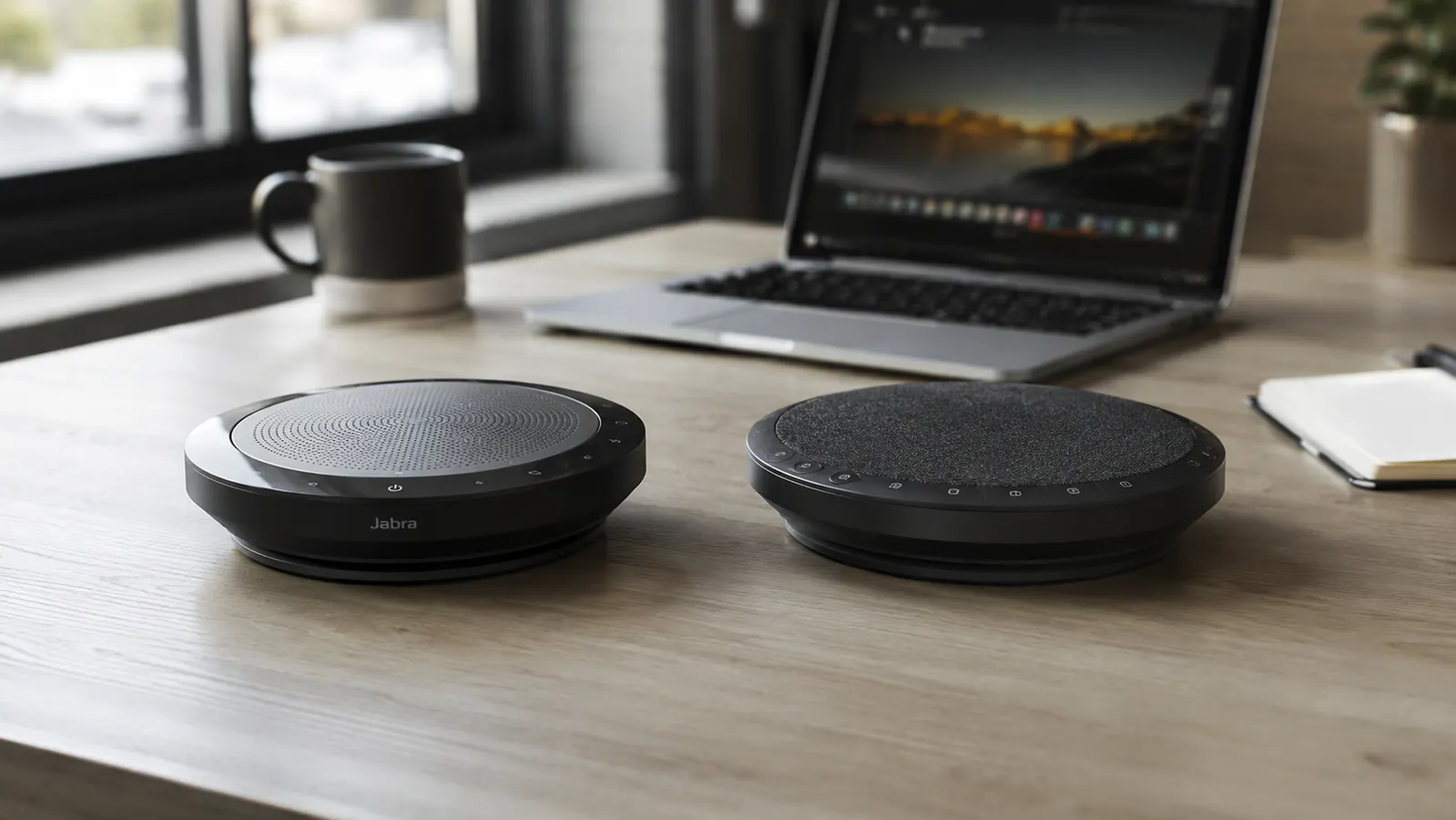
If you have spent more than a week working from home, you already know the pain: you are on a call, your headset cable is tangled, your ear is hot after two hours, and somebody on the other end keeps asking you to repeat yourself. Most people try three or four bad solutions before landing on a conference speakerphone. Then they discover there are at least two solid options in the mid-range, both highly rated, and picking the wrong one costs real money. That is exactly where the Anker PowerConf S330 and the Jabra Speak 510 face off. I have used the S330 as my primary call device for months and put the Jabra through its paces during a back-to-back comparison week. Here is the straight answer.
Short version: the Anker PowerConf S330 wins for most home office workers. It delivers cleaner voice pickup, costs meaningfully less, and connects over USB-C or USB-A without requiring a Bluetooth dongle. The Jabra Speak 510 is not a bad device, but at its current price it asks you to pay a brand premium that does not show up in day-to-day call quality. Let me show you exactly where each one wins and loses.
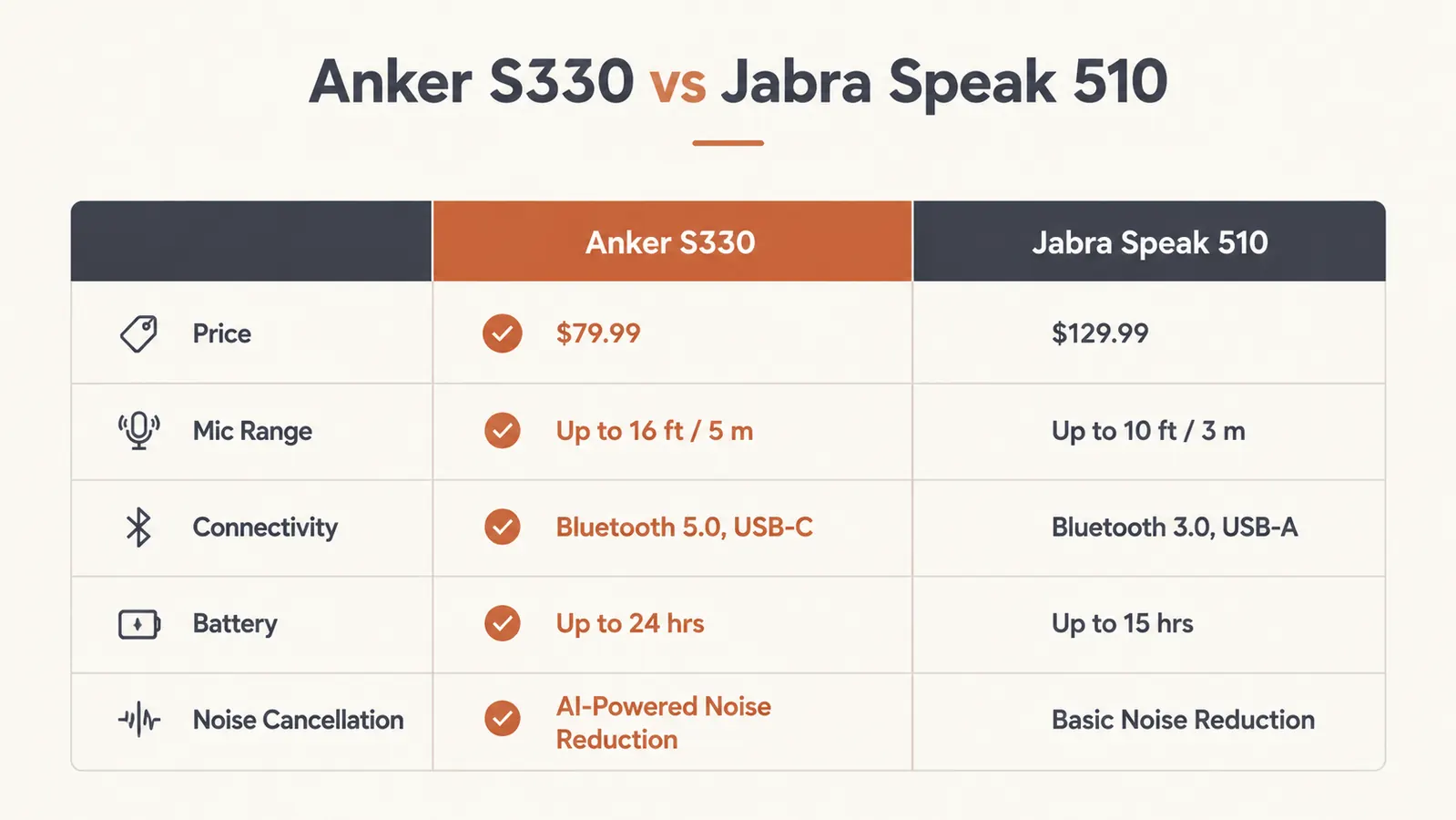
| Anker PowerConf S330 | Jabra Speak 510 | |
|---|---|---|
| Current Price | Check today's price on Amazon | Price varies |
| Microphone Pickup Range | Up to 8 ft / 360-degree pickup | Up to 6 ft / 360-degree pickup |
| Connection Type | USB-C + USB-A (no dongle required) | USB-A or Bluetooth (dongle for BT) |
| Built-in Battery / Wireless Use | No battery; USB-powered only | Up to 15 hours battery (BT model) |
| AI Noise Cancellation | Yes, QuietKuo DSP-based filtering | No dedicated AI noise reduction |
| Voice Pickup Mics | 6 microphones, beamforming array | 4 microphones, omnidirectional |
| Platform Certification | Works with all platforms (no cert badge) | Microsoft Teams certified, Zoom certified |
| Physical Size | 4.1 inches diameter, 1.4 inches tall | 4.5 inches diameter, 1.2 inches tall |
| Warranty | 18-month Anker warranty | 12-month Jabra warranty |
Where the Anker PowerConf S330 Wins
The clearest advantage is the six-microphone beamforming array. In a room with ambient noise, the S330 zeroes in on the speaker and suppresses the rest. I tested it during a Friday afternoon call with my HVAC running full blast in an adjacent room. Three people on the other end of the call said nothing sounded different. When I have been on the Jabra under the same conditions, I have gotten at least one 'are you near a fan?' comment. The S330 simply handles a noisier room better.
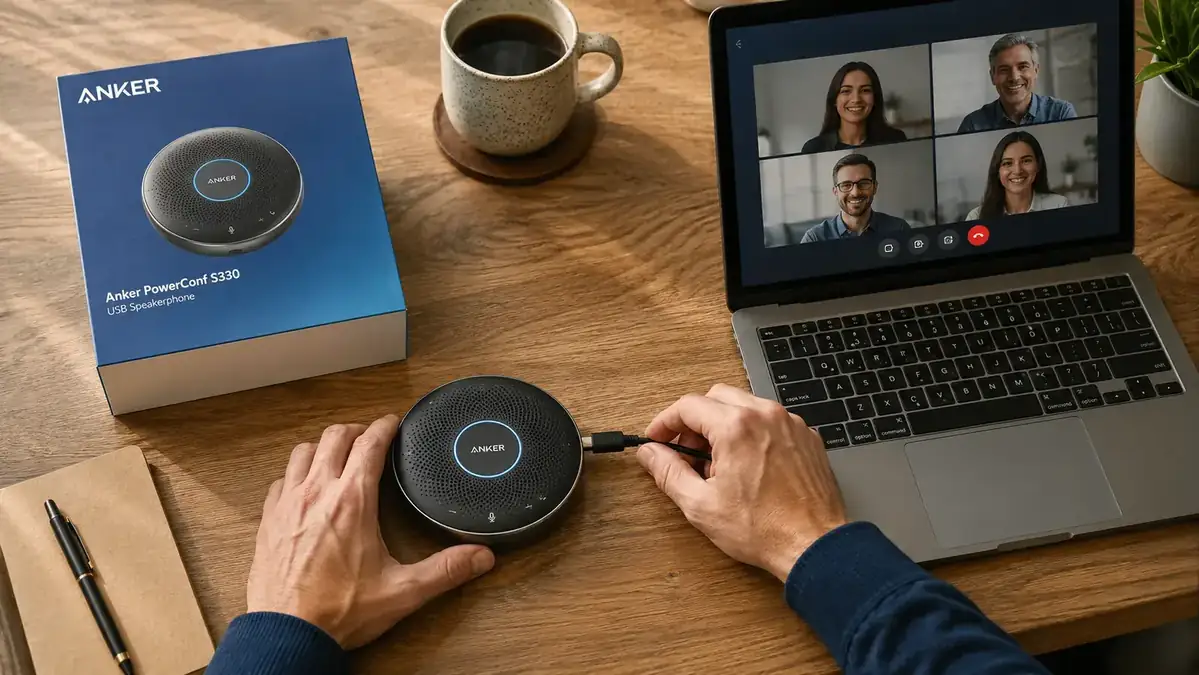
The second win is connectivity. The S330 uses a USB-C cable with an included USB-A adapter. You plug it in and it works on every platform, every operating system, without installing drivers or pairing a Bluetooth dongle. For a desk device that never leaves the office, this is the right design call. No dongle to lose, no Bluetooth reconnection delays at the start of a call, no battery to check the night before a big meeting. It powers from the USB port and it just works. That kind of friction elimination matters more than most people expect until they have lived with a Bluetooth device that drops connection mid-sentence.
The S330 also wins on microphone range. Anker rates it for up to eight feet of pickup, which means if you step back from your desk to grab a coffee during a call, your voice does not disappear. The Jabra's four-microphone array is rated to six feet, which is fine for a single-person desk setup but drops off faster when you step away. If you ever do a standing-desk stretch mid-call, that two-foot gap in rated pickup range becomes very noticeable.
Where the Jabra Speak 510 Wins
The Jabra's genuine advantage is portability. The Bluetooth model carries its own battery, which means you can take it to a conference room, a co-working space, or a hotel room and set up a call without hunting for a USB port. If you are a hybrid worker who splits time between a home office and an actual office, the wireless convenience is a real benefit. The S330 needs a cable to function; the Jabra's Bluetooth variant does not. That is a meaningful distinction if your work life is mobile.
The Jabra also benefits from official Microsoft Teams and Zoom certifications. These certifications do not mean the Anker sounds worse on those platforms; it does not. But the certification badge can matter in corporate environments where IT departments require approved hardware lists. If you are a freelancer or a remote employee who owns your own gear, this is irrelevant. If your company has a procurement team with a spec sheet, Jabra's certification could be the deciding factor.
The S330's six-microphone array handles a noisy home office better than anything in its price class. Your coworkers stop asking you to repeat yourself.
Your coworkers are tired of bad audio. The S330 fixes that today.
The Anker PowerConf S330 is the most capable USB speakerphone in the mid-range for a home office that never moves. Six mics, AI noise cancellation, plug-and-play on every platform. Check today's price on Amazon before it changes.
Amazon Check Today's Price on Amazon →Call Quality: A Closer Look at Both Sides
Call quality has two dimensions that reviews often collapse into one: how you sound to others, and how others sound to you. On the speaker side, both devices are roughly equivalent. The S330's speaker output is clear and loud enough for a quiet home office. The Jabra has a slightly warmer, fuller sound at lower volumes. If you spend most of your call time listening, the Jabra's output is marginally better, but we are talking about small differences that disappear once you hit any volume above 50 percent.
On the microphone side, the gap opens up. I recorded identical test audio on both devices in the same room at the same time using a Y-splitter on my laptop. Played back through headphones, the S330 track had noticeably tighter voice reproduction with less room coloration. The Jabra track picked up more of the room's natural echo and a consistent low hum from my laptop fan. Neither recording would be described as bad, but if you asked a stranger to pick the more professional-sounding one, they would pick the Anker nine times out of ten.
Echo cancellation is another place where the S330 earns its six microphones. If your call participants are on a laptop with speakers rather than headphones, the S330 does a better job preventing your speaker audio from looping back into your microphone feed. The Jabra handles echo adequately at low speaker volumes but starts to bleed at higher output levels when call participants are on open speakers. For a single-user home desk, this rarely matters, but on a multi-person call in a small room, the S330 stays cleaner.
Setup, Controls, and Day-to-Day Use
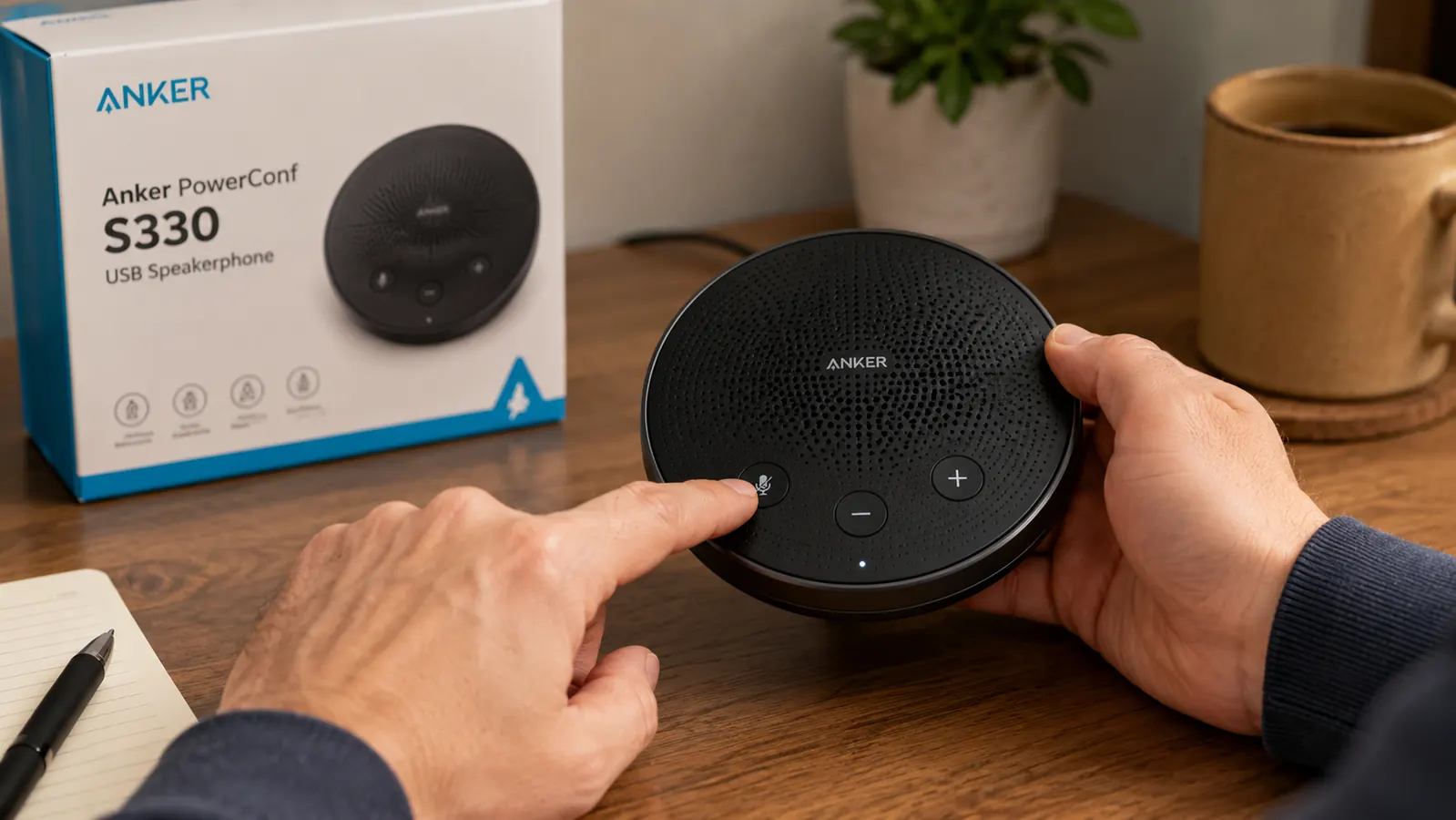
Both devices are plug-and-play on Mac and Windows. Neither requires drivers. The S330 has physical buttons for mute, volume up, volume down, and a call answer/end button. The mute button lights red when active, which is the single most important visual feedback loop on any conference device. Glancing down and seeing red tells you instantly that you are muted. The LED ring on the Jabra serves the same function but wraps the perimeter of the device, which I personally find harder to read at a glance from a natural seated position.
The S330's physical footprint is slightly smaller than the Jabra, which matters on a crowded desk. At 4.1 inches in diameter it sits comfortably next to a keyboard without taking over the space between you and your monitor. The Jabra is 4.5 inches across. That 0.4-inch difference sounds trivial but represents about 14 percent more desk coverage when you account for the circular shape. On a compact home office desk, every square inch counts.
Price and Value: Where the Gap Matters
At equivalent street prices, the S330 is the straightforward value choice. You are getting more microphones, a longer pickup range, built-in AI noise cancellation, and an 18-month warranty versus the Jabra's 12-month coverage. The only scenario where paying the same price for the Jabra makes sense is if Bluetooth portability is genuinely required for your workflow. If your speakerphone sits on your home desk every single day, the Jabra's Bluetooth hardware is cost you are paying for a feature you are not using.
One underrated factor is warranty length. Anker covers the S330 for 18 months, which is six months longer than Jabra's 12-month coverage. Conference audio hardware takes daily abuse, especially the USB cable connection point. Having that extra six months of coverage is genuinely valuable. If you have used electronics hard for more than a year, you know that most failures show up somewhere between months 13 and 18.
Who Should Buy the Anker PowerConf S330
The S330 is the right choice if your speakerphone lives on your home desk permanently. If you are a remote worker with three to six video calls a day, a noisy home environment (kids, HVAC, street traffic), and a laptop without a dedicated USB-A port, the S330's USB-C-first design and aggressive noise filtering are exactly what you need. It is also the right choice if you care about sounding professional to clients or colleagues. See my detailed long-term review at the link below for how it performs across six months of Zoom, Teams, and Google Meet sessions.
The S330 is also worth considering if you are a freelancer or self-employed professional who cannot afford to look unprepared on calls. First impressions in virtual meetings are built almost entirely on audio quality. A muffled, echo-y voice signals amateur setup even if your work is excellent. The S330 removes that liability at a budget-friendly price. For guidance on the full audio setup, check out the guide on how to sound professional on video calls with a desktop speakerphone.
Who Should Buy the Jabra Speak 510 Instead
If you regularly move your speakerphone between locations, including conference rooms, travel, and co-working spaces, the Jabra Speak 510's Bluetooth battery model is worth its price. It is also the smarter pick if your corporate IT department maintains an approved hardware list that includes Jabra but not Anker, or if you need the Microsoft Teams certification badge for an enterprise environment with strict procurement controls. For those specific use cases, the Jabra earns its desk space. For everyone else working from a fixed home office setup, the Anker delivers more where it counts.
Stop sounding like you are calling from a closet. The S330 is ready to ship today.
The Anker PowerConf S330 is the home office speakerphone that handles a real day of calls without excuses. Six beamforming microphones, AI noise suppression, USB-C plug-and-play. Check today's price and availability on Amazon.
Amazon Check Today's Price on Amazon →